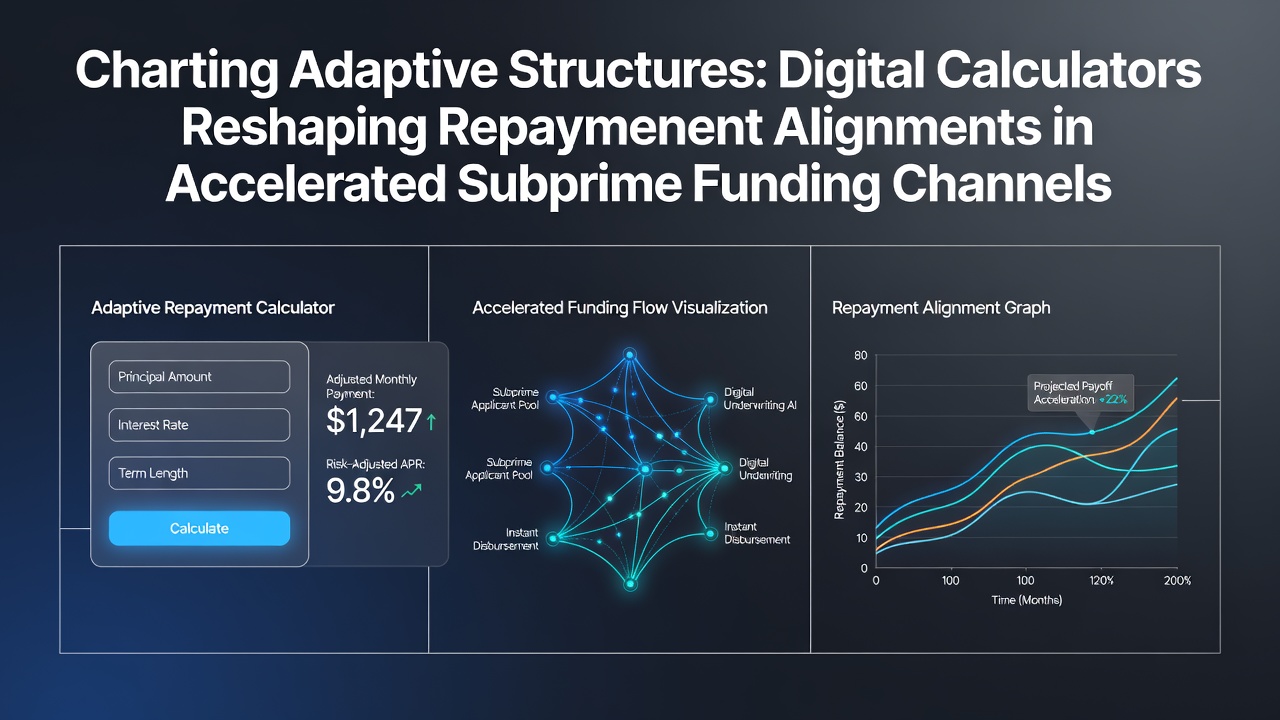
Charting Adaptive Structures: Digital Calculators Reshaping Repayment Alignments in Accelerated Subprime Funding Channels
Subprime funding channels have long operated under conditions where borrowers carry elevated risk profiles due to credit histories or income variability, yet digital calculators now permit lenders to construct repayment alignments that adapt in real time to changing variables such as interest rate fluctuations and payment acceleration options, while research from regulatory bodies tracks these shifts across multiple markets.
These tools integrate borrower data with algorithmic models that recalculate amortization schedules on demand, allowing accelerated funding channels to maintain compliance with varying regulatory thresholds, and data shows that adoption of such systems expanded notably by August 2026 as platforms updated their interfaces to handle complex scenarios involving multiple loan products simultaneously.
Mechanics of Digital Calculators in Subprime Contexts
Calculators designed for subprime environments process inputs including credit scores below conventional thresholds, debt-to-income ratios, and proposed acceleration clauses, then output revised payment streams that balance lender recovery timelines against borrower capacity, whereas traditional spreadsheet methods required manual adjustments that introduced delays and inconsistencies across portfolios.
Advanced versions incorporate scenario branching, so one simulation might test a 15 percent payment increase over six months while another factors in potential rate resets, and observers note that these capabilities reduce processing times from days to minutes in high-volume origination environments.
Adaptive Structures and Repayment Realignment
Adaptive structures emerge when calculators link directly to funding platforms, enabling repayment alignments that shift dynamically as new information arrives from credit bureaus or employment verification services, although core parameters remain anchored to the original loan agreement to preserve contractual integrity.
In practice, a lender might deploy these systems to model early payoff impacts on subprime auto or personal loans, adjusting for prepayment penalties or interest savings, and figures from industry analyses indicate that such modeling supports faster capital recycling within accelerated funding channels without elevating default probabilities beyond established risk bands.

Integration with Accelerated Funding Channels
Accelerated funding channels rely on rapid disbursement paired with structured repayment oversight, and digital calculators supply the quantitative backbone that lets originators verify alignment between incoming capital demands and outgoing cash flows from borrowers, while regulatory updates in various regions have encouraged standardized data formats that facilitate smoother calculator interoperability.
Take one platform operator who integrated calculator outputs with automated underwriting engines, resulting in repayment schedules that automatically flag potential misalignments when borrower payment history deviates from projections, and reports compiled by the Consumer Financial Protection Bureau document similar patterns across U.S. nonbank lenders through mid-2026.
Regional Variations and Data Trends
Outside the United States, Canadian regulators at the Bank of Canada have published aggregate statistics on digital tool usage in subprime segments, revealing that calculator-assisted realignments correlate with modest reductions in average loan tenure when acceleration features activate early, whereas European Central Bank monitoring focuses on cross-border data flows that support similar calculator deployments in member states.
These regional datasets collectively illustrate how digital systems standardize complex calculations that once varied widely by institution, producing more uniform repayment structures even as local credit conditions differ.
Conclusion
Digital calculators continue to refine the operational core of subprime funding by enabling precise, data-driven adjustments to repayment alignments within accelerated channels, and ongoing collection of performance metrics through 2026 provides the empirical foundation for further refinements across global markets.